
ARTEX Traffic - Previdian Threat Intelligence Report November 2026

Previdian Threat Intelligence | 16 November 2026
Observation Period: 18 October – 15 November 2026
Threat: ARTEX-associated reconnaissance and exploitation activity
Attribution Confidence: Moderate
Exploitation Attempt Confidence: High
Executive Summary
Previdian has identified exploitation attempts associated with ARTEX, an LLM-driven offensive security framework, across its global honeypot network.
Between 18 October and 15 November 2026, our sensors recorded 52 HTTP records containing explicit ARTEX markers, originating from 10 source IP addresses. Further investigation of these sources identified 3,651 related HTTP records involving application discovery, authentication probing, remote code execution attempts, path traversal and attempts to retrieve sensitive configuration data.
The most significant activity targeted Oracle WebLogic, Langflow and Flowise, with additional payloads associated with Apache Struts, Log4j and PHPUnit.
The observed activity included:
- Base64-encoded command-execution payloads containing unique ARTEX identifiers.
- WebLogic console traversal and Java execution expressions.
- Langflow account registration, authentication retries and attempts to execute Python code.
- Requests designed to extract environment variables, credentials and application configuration files.
- Extensive multi-technique exploitation attempts against a WebLogic decoy.
- User agents and request paths explicitly identifying ARTEX reconnaissance components.
The evidence supports likely ARTEX usage, although attacker-controlled identifiers cannot independently establish which framework executed every request or who operated it.
Key Intelligence Findings
| Finding | Assessment |
|---|---|
| ARTEX-Marked Activity | 52 HTTP records from 10 source IPs |
| Related Activity | 3,651 HTTP records across the same sources |
| Primary Targets | Oracle WebLogic, Langflow and Flowise |
| Additional Techniques | Log4Shell, Struts OGNL, PHPUnit execution, JSP upload |
| Tool Attribution | Moderate confidence in ARTEX usage for marker-bearing traffic |
| Exploit Intent | High confidence based on captured execution and file-read payloads |
| Confirmed Compromise | Not established in reviewed telemetry |
| Threat Actor Attribution | Unknown |
Intelligence Assessment
Our assessment is that multiple sources used, or deliberately identified themselves as using, ARTEX while conducting reconnaissance and exploitation attempts against internet-facing application interfaces.
The strongest evidence combines explicit ARTEX identifiers with command-execution payloads and application-specific exploitation techniques.
We have not established that the ten source addresses belong to a single coordinated campaign.
We also cannot determine whether individual requests were selected autonomously by an LLM, executed by conventional automation or initiated by human operators.
These limitations are important when interpreting activity associated with agentic offensive tooling.
Background: ARTEX Offensive Framework
ARTEX is an LLM-driven penetration-testing framework capable of coordinating reconnaissance, vulnerability discovery and exploitation workflows.
The framework is designed to combine planning with tool execution, potentially allowing an agent to adapt subsequent actions based on responses returned by target applications.
ARTEX has attracted attention following public reporting of its use in malicious operations.
On 22 October 2026, Wiz Research described ARTEX-associated reconnaissance and authentication probing during a campaign targeting IT and software vendors.
On 30 October 2026, Google Threat Intelligence Group and Mandiant documented the use of ARTEX and related agentic offensive frameworks by multiple threat actors.
Additional Datadog Security Labs research provides context on ARTEX-associated operations in AWS environments.
These reports establish the framework's relevance to the current threat landscape but do not identify the operators responsible for Previdian's observed activity.
Alternative AI Offensive Security Frameworks
ARTEX is one of several AI-assisted and agentic offensive security frameworks. Other examples include PentestGPT, PentAGI, Strix, Shannon and HexStrike AI.
These frameworks vary in architecture, autonomy and intended use, from AI-assisted penetration testing to more autonomous reconnaissance and vulnerability exploitation workflows.
These alternatives were not evaluated or systematically investigated as part of this report. Our analysis focuses specifically on traffic containing ARTEX indicators and related activity observed across Previdian's honeypot network.
Telemetry Scope and Methodology
The investigation examined Previdian's retained honeypot HTTP and event telemetry available through 16 November 2026.
The searchable inventory contained approximately 118.8 million log records, including 19,483,229 full HTTP records and 99,287,650 event records, plus an older finding.
Our investigation began with searches for ARTEX identifiers across request paths, user agents, HTTP headers, request bodies and event fields.
After validating candidate records, we pivoted into the complete available HTTP histories of the ten source IP addresses.
This produced 3,651 related HTTP records for further examination.
Requests and responses were reviewed to identify exploitation techniques, attempted objectives and observed outcomes. Selected encoded payloads were decoded for analysis without execution.
The investigation identified 49 plaintext ARTEX-marker records, with three additional records identified through decoding payloads from the related source histories.
The source-level pivots provide investigative context. They do not establish that every associated request was generated by ARTEX.
All dates in this report use UTC. Times are approximate unless otherwise indicated.
Observed Exploitation Activity
1. Langflow: Authentication Probing and Attempts to Extract Secrets
Source IP: 31.22.91[.]156
Activity Period: 15–22 October 2026
Related HTTP Records: 298
Explicit ARTEX-Marked Records: 5
This source generated 47 Langflow-related HTTP records and 251 Flowise-related records.
The Langflow sequence provides one of the clearest examples of request modification following application feedback.
Observed Timeline
| Date | Observed Activity | HTTP Response |
|---|---|---|
| 18 Oct | Registered account artex26019 using POST /api/v1/users/ | 201 Created |
| 18 Oct | Submitted JSON credentials to /api/v1/login | 422 Unprocessable Entity |
| 18 Oct | Retried login with form-encoded credentials | 400, waiting for approval |
| 18 Oct | Requested restricted monitoring endpoints | 403 Forbidden |
| 18 Oct | Probed a public-flow execution endpoint | 403, flow not public |
| 19 Oct | Submitted Python execution expressions to /api/v1/validate/code | 403 Forbidden |
| 20 Oct | Submitted further encoded execution and secret-read payloads | 403 Forbidden |
The initial registration request returned an account with:
{
  "username": "artex26019",
  "is_active": false,
  "is_superuser": false
}
The registration succeeded according to the application response, but the account did not receive active access.
The subsequent login attempt used JSON rather than the form-encoded data required by the endpoint.
After receiving an HTTP 422 response, the source retried approximately six seconds later using the expected request format.
That request was also rejected because the account was awaiting approval.
The change in format is consistent with feedback-driven testing. However, HTTP telemetry alone cannot distinguish an LLM-directed correction from a scripted or human-directed retry.
Attempted Remote Code Execution
The source subsequently submitted Python payloads to:
POST /api/v1/validate/code
The requests attempted to retrieve environment variables and sensitive application files, including:
/proc/1/environ.envconfiguration files- Process environment variables
- Other local configuration data
- System command output
Six records contained execution or secret-read payloads. One additional record was a basic code-validation probe.
All seven returned 403.
The execution expressions are consistent with the code-validation remote code execution technique documented in CVE-2025-3248.
The same request surface overlaps with the vulnerability described in CVE-2026-0768.
The captured traffic does not uniquely distinguish these advisories or establish two separate successful exploit chains.
The Horizon3.ai technical analysis and ZDI advisory provide additional detail on the associated execution techniques.
Outcome: Attempted code execution and secret retrieval. No successful execution confirmed.
2. Langflow and Flowise: File-Read and Credential Enumeration Attempts
The same source conducted additional probing against Langflow and Flowise file-handling interfaces.
Two Langflow requests attempted path traversal through the profile-picture endpoint:
/api/v1/files/profile_pictures/../secret_key
/api/v1/files/profile_pictures/../langflow.db
These requests match the path traversal technique associated with CVE-2026-33497, documented in the Langflow security advisory.
Both requests returned 400.
Related Flowise activity attempted to enumerate credential-related APIs and retrieve protected files.
A request to:
POST /api/v1/openai-assistants-file
supplied a traversal value through the fileName parameter targeting /etc/passwd.
This matches the arbitrary file-read technique associated with CVE-2024-36420, as described in GitHub Security Lab's Flowise research.
The request returned 401 Unauthorized.
Other requests received HTTP 200, but inspection showed generic application HTML rather than authenticated API responses or retrieved credentials.
Outcome: Attempted file access and credential enumeration. No confirmed protected-data disclosure.
3. Oracle WebLogic: ARTEX Command-Execution Markers
Source IP: 104.219.250[.]32
Activity Period: 20–23 October 2026
Related HTTP Records: 128
Explicit ARTEX-Marked Records: 6
This source conducted activity against Oracle WebLogic and PeopleSoft interfaces.
On 23 October, six records explicitly contained ARTEX identifiers.
Three requests supplied invalid Java class references, while another three contained base64-encoded command-execution payloads.
The requests used WebLogic console traversal paths, including:
/console/css/%252e%252e%252fconsole.portalThe double-encoded traversal syntax matches the authentication-bypass technique associated with CVE-2020-14882.
Decoded Execution Payload
One encoded request contained the following command:
echo ARTEX479630; id; hostname; uname -r; nprocTwo additional requests used equivalent commands with different identifiers:
ARTEX677334
ARTEX724070
The commands attempted to identify the executing user and collect basic host information.
This would provide an execution check and environmental context if the vulnerable application actually executed the supplied commands.
The three marker-bearing command requests targeted three WebLogic decoys within approximately one minute on 23 October.
Nearby requests supplied the invalid class:
com.artex.NoSuchClassZZZ(1)The relationship between the invalid-class probes and execution payloads is consistent with a technique for distinguishing successful execution from error responses.
However, the requests alone do not establish the operator's intended testing logic.
Additional WebLogic Exploitation Attempts
The broader source history contained:
| Technique | HTTP Records |
|---|---|
SOAP payloads using XMLDecoder and ProcessBuilder | 10 |
| Jython execution expressions | 15 |
| Explicit ARTEX-marked probes and commands | 6 |
All ten SOAP records returned HTTP 500.
Several console requests returned HTTP 200 with text resembling Unix command output.
Crucially, the affected sensors were WebLogic decoys configured to emulate command output.
The sensor implementation returns predefined responses when supplied handles contain commands such as id, whoami or uname.
The captured responses matched that emulation.
Outcome: Confirmed command-execution attempts against WebLogic decoys. No evidence of actual host command execution.
4. Oracle WebLogic: Extended Multi-Technique Exploitation Activity
Source IP: 186.244.215[.]55
Observation Date: 10 November 2026
Related HTTP Records: 2,918
Explicit ARTEX-Marked Records: 15
This source generated the largest volume of related traffic identified during the investigation.
The activity spanned approximately 20 hours, beginning around 01:56 UTC and ending around 22:16 UTC.
Fifteen requests used the following user agent:
Mozilla/5.0 (artex-i1086)Those explicitly labelled requests occurred during a short window in the afternoon and primarily probed MOVEit-style and other application interfaces on a WebLogic decoy.
Most returned 404.
The remainder of the source's traffic contained a wider range of exploitation techniques.
Payload Classification
| Technique | Matching Records | Observed Intent |
|---|---|---|
Java ProcessBuilder | 50 | Operating system command execution |
WebLogic Coherence ShellSession | 32 | WebLogic console execution |
| JNDI expressions | 210 | Log4j lookup and callback probing |
| Apache Struts OGNL | 6 | Command execution through crafted HTTP headers |
| PHPUnit execution payload | 1 identified | PHP code execution |
| JSP upload payload | 1 identified | Attempted deployment of a command shell |
These categories overlap and are based on matching payload content, not deduplicated exploit sessions.
The JNDI expressions appeared across request headers, URIs and bodies, including obfuscated variations associated with Log4Shell testing.
The WebLogic requests included command-execution expressions, SOAP deserialization payloads and time-delay validation attempts.
Some payloads also supplied external callback destinations.
This activity is consistent with broad, multi-technique exploitation testing against an exposed application surface.
However, the fifteen explicitly ARTEX-labelled requests do not prove that the remaining 2,903 records were produced by the same framework.
The record timestamps also do not prove that the source maintained continuous exploitation activity throughout the observation window.
Outcome: Extensive exploitation attempts associated at source level with ARTEX-labelled reconnaissance. Successful exploitation not confirmed.
Vulnerability Mapping and KEV Status
The observed traffic contained signatures associated with multiple published vulnerabilities.
Mappings were made using captured request structure, payload content and available vulnerability research.
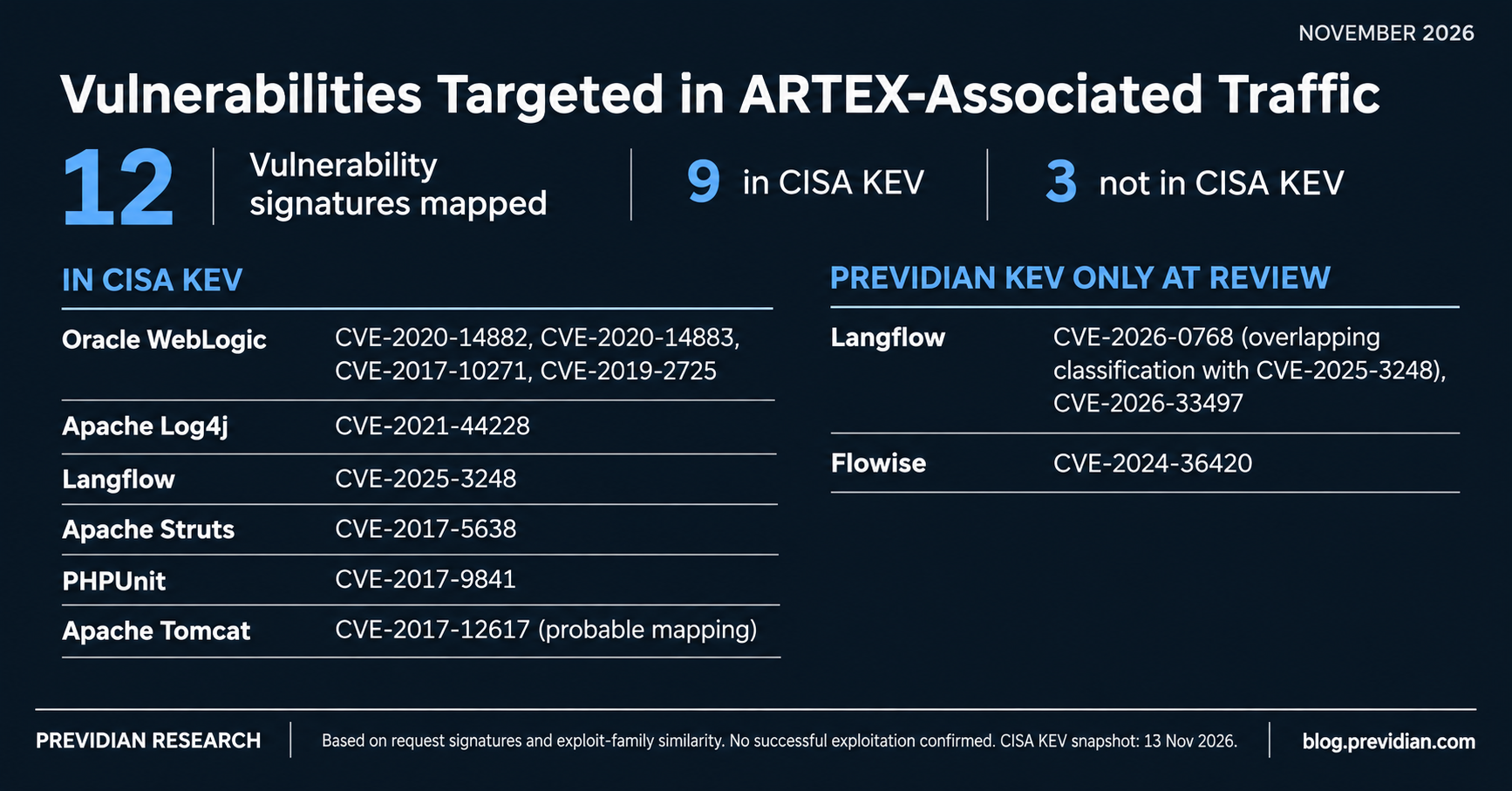
A request matching a known exploit signature establishes attempted exploitation of that technique, not that the receiving software was vulnerable or that exploitation succeeded.
The CISA KEV comparisons below use the catalog snapshot dated 13 November 2026, containing 1,781 entries. Previdian KEV status reflects the records checked on 16 November.
| Vulnerability | CVE | CISA KEV | Previdian KEV |
|---|---|---|---|
| WebLogic console authentication bypass | CVE-2020-14882 | Yes | Yes |
| WebLogic console handle RCE | CVE-2020-14883 | Yes | Yes |
| WebLogic WLS-WSAT deserialization | CVE-2017-10271 | Yes | Yes |
| WebLogic AsyncResponseService RCE | CVE-2019-2725 | Yes | Yes |
| Log4Shell | CVE-2021-44228 | Yes | Yes |
| Langflow code-validation RCE | CVE-2025-3248 | Yes | Yes |
| Langflow code-parameter injection | CVE-2026-0768 | No | Yes |
| Langflow profile-picture traversal | CVE-2026-33497 | No | Yes |
| Flowise arbitrary file read | CVE-2024-36420 | No | Yes |
| Apache Struts OGNL RCE | CVE-2017-5638 | Yes | Yes |
PHPUnit exposed eval-stdin.php RCE | CVE-2017-9841 | Yes | Yes |
| Apache Tomcat JSP upload RCE | CVE-2017-12617 | Yes | Yes |
Mapping Confidence and Limitations
The WebLogic console traversal, Struts OGNL, Log4Shell, Langflow code-validation and Flowise file-read payloads provided distinctive signatures for their corresponding vulnerability families.
The SOAP deserialization payloads are consistent with the techniques associated with CVE-2017-10271 and CVE-2019-2725. The request paths and gadgets do not independently establish the target version or patch state.
The Langflow code-validation requests overlap between CVE-2025-3248 and CVE-2026-0768. Their appearance in the table should not be interpreted as two separate observed exploit chains.
The Apache Tomcat mapping is less certain. A JSP upload attempt matched the technique associated with CVE-2017-12617, but the receiving sensor was a WebLogic decoy, not an established Tomcat installation.
Additional requests probed interfaces associated with Langflow CVE-2026-33017 and WebLogic CVE-2018-2894. Those were excluded from the confirmed exploit-attempt mappings because the captured requests did not demonstrate the necessary exploit material.
The classifications were also compared with published technical references, including Apache Struts S2-045, Apache Log4j security documentation, Apache Tomcat security advisories, Oracle's CVE-2019-2725 alert, and the WebLogic console exploit reference.
Vulnerabilities Outside CISA KEV
Three vulnerabilities associated with the observed traffic were present in Previdian KEV but absent from the CISA catalog snapshot used in this review:
- CVE-2026-33497: Langflow profile-picture path traversal.
- CVE-2024-36420: Flowise arbitrary file read.
- CVE-2026-0768: Langflow code-parameter injection, overlapping with the observed CVE-2025-3248 technique.
This distinction is relevant to security teams prioritizing vulnerabilities based on exploitation evidence.
CISA KEV remains an important baseline. Previdian complements it by providing additional vulnerability intelligence, including directly observed attempts where available.
Indicators of Compromise and Hunting Indicators
The following addresses generated records containing explicit ARTEX markers.
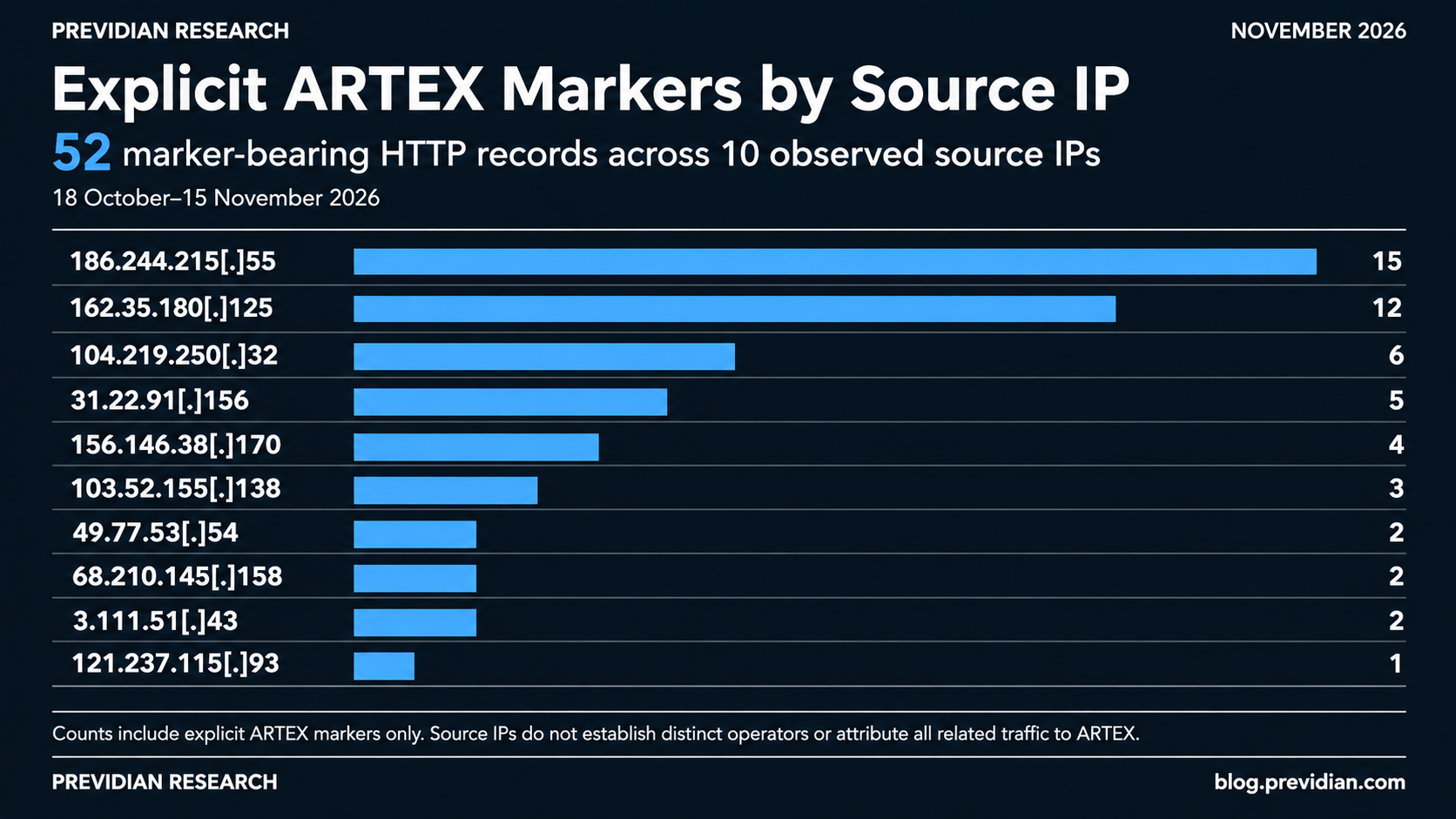
These are observed source indicators, not proof of compromise or attribution to a specific actor. Historical traffic should be correlated with request context before taking action.
| Source IP | Marked Activity | Records | Indicator |
|---|---|---|---|
31.22.91[.]156 | 18–20 Oct | 5 | Langflow artex26019, Flowise /artex |
104.219.250[.]32 | 23 Oct | 6 | WebLogic execution markers |
103.52.155[.]138 | 21 Oct | 3 | artex-origindisc |
121.237.115[.]93 | 26 Oct | 1 | Mozilla/5.0 artex |
156.146.38[.]170 | 29 Oct | 4 | artex-recon/1.0 |
162.35.180[.]125 | 9–15 Nov | 12 | artex-sni-scan |
49.77.53[.]54 | 10 Nov | 2 | artex-recon/1.0 |
186.244.215[.]55 | 10 Nov | 15 | Mozilla/5.0 (artex-i1086) |
68.210.145[.]158 | 12 Nov | 2 | ARTEX-recon/1.0 |
3.111.51[.]43 | 15 Nov | 2 | /artex-probe-o20v0gt9 |
The table above is ordered by first seen activity.
We additionally compared the observed source IPs against 36 previously published indicators collected from Datadog, Wiz and the FBI FLASH dated 13 November 2026.
No source-IP matches were identified within the searched fields on the previously mentioned sources.
Previdian identified an exact IOC overlap with Amazon Threat Intelligence's ARTEX investigation.
Amazon associated 31.22.91[.]156 with its ARTEX Campaign 1, targeting AI applications and credentials. Previdian independently observed 298 related HTTP records from the same IP between 15 and 22 October, including Langflow exploitation attempts consistent with CVE-2025-3248.
The overlapping infrastructure, timeframe and techniques corroborate Amazon's findings, although common operator attribution remains unconfirmed.
Network and Application Indicators
Additional hunting strings include:
artex-recon/1.0
ARTEX-recon/1.0
artex-sni-scan
artex-origindisc
artex-i1086
com.artex.NoSuchClassZZZ
artex26019
The WebLogic payloads additionally contained execution markers following this pattern:
ARTEX<number>Associated application paths included:
/api/v1/validate/code
/api/v1/users/
/api/v1/login
/api/v1/files/profile_pictures/
/api/v1/openai-assistants-file
/console/css/%252e%252e%252fconsole.portal
/wls-wsat/
/_async/AsyncResponseService
These paths are not inherently malicious. They become useful when correlated with traversal sequences, execution payloads, suspicious authentication activity or other supporting evidence.
MITRE ATT&CK Mapping
The following mappings describe attempted behaviour observed in payloads, rather than confirmed post-exploitation activity.
| Technique | ATT&CK ID | Supporting Evidence |
|---|---|---|
| Exploit Public-Facing Application | T1190 | WebLogic, Langflow and Flowise exploit attempts |
| Command and Scripting Interpreter: Python | T1059.006 | Langflow Python execution payloads |
| Unsecured Credentials: Credentials in Files | T1552.001 | Attempts to access .env and other configuration files |
| System Information Discovery | T1082 | Commands attempting to collect hostname, kernel and processor information |
No successful execution, credential acquisition or host discovery is implied by these mappings.
Detection and Defensive Recommendations
1. Identify ARTEX-Associated Traffic
Security teams should search relevant HTTP, WAF and application telemetry for explicit ARTEX identifiers.
Markers may appear in user agents, request paths, account names or encoded command payloads.
However, simple substring searches can produce false positives.
During our investigation, a broad search returned 91 records containing the substring artex.
Manual validation rejected 42 incidental matches, leaving 49 plaintext records. Decoding selected payloads from the associated source histories identified three more.
Case-insensitive searches that require non-letter boundaries around the ARTEX identifier can improve initial triage, but still require manual review.
2. Correlate Markers With Exploitation Techniques
Higher-confidence detections should combine framework indicators with suspicious application behaviour.
Examples include authentication retries following validation errors, path traversal, attempts to read local secret files, command-execution expressions and requests associated with known vulnerable endpoints.
Generic browser, Python or curl user agents are insufficient to identify ARTEX.
3. Validate Exploitation Outcomes
An HTTP 200 response does not necessarily indicate successful exploitation.
For real applications, correlate suspicious requests with host-level evidence, including process creation, file modifications, authenticated actions and unexpected outbound communications.
EDR, runtime monitoring and tools can help establish whether commands actually executed.
The WebLogic observations in this report demonstrate why this distinction matters: responses resembling successful command execution were generated by the decoy implementation.
4. Prioritize Exposed Vulnerable Services
Review internet-facing instances of the affected applications and confirm whether vulnerable versions are present.
Prioritize supported remediation for the applicable vulnerabilities, particularly where administrative interfaces or code-execution functionality are exposed. Our continuous Previdian Exposure service can help with this.
Where patching cannot be completed immediately, consider restricting access to vulnerable interfaces and deploying tested temporary controls, such as Virtual Patches.
5. Investigate Historical Activity
Use the observed IP addresses and request indicators to search historical telemetry.
Pay particular attention to the period between 18 October and 15 November 2026.
Historical matches should be reviewed in context, including the requested path, payload, response, application version and any resulting host-level activity.
Attribution and Confidence Assessment
We assess with moderate confidence that ARTEX was used in at least some of the marker-bearing activity.
This assessment is supported by repeated explicit framework identifiers across unrelated HTTP fields, including user agents, account names, request paths and decoded command payloads.
However, these values are controlled by the requesting client and can be reproduced or deliberately spoofed.
We have high confidence that exploitation attempts occurred. The captured requests contain recognizable command-execution expressions, traversal payloads and attempts to read sensitive files.
We have not established that the ten sources represent a single actor or coordinated campaign.
No reliable evidence ties these observations to a particular nation-state, criminal group or publicly reported ARTEX operation.
Likewise, we cannot determine the degree of autonomous decision-making involved.
The Langflow retry sequence is consistent with adaptive testing, but does not distinguish autonomous LLM execution from traditional automation.
Conclusion
Previdian's November 2026 investigation identified ARTEX-associated HTTP activity spanning ten source IP addresses and multiple application exploitation techniques.
The strongest observations included encoded ARTEX execution markers against WebLogic, authentication and secret-read attempts against Langflow, and extensive multi-technique probing associated with an ARTEX-labelled source.
The traffic provides evidence of offensive experimentation with application-specific payloads and known vulnerability techniques.
It does not establish successful compromise, a common operator across the sources or fully autonomous exploitation.
As agentic offensive frameworks develop, defenders should expect framework identifiers, generated payloads and application-response-driven probing to appear in their telemetry. Reliable assessment will depend on combining request evidence with application and host outcomes rather than assuming every submitted payload was successful.
Previdian will continue monitoring ARTEX-associated activity across its honeypot network and mapping observed exploitation techniques to vulnerabilities and available defensive intelligence.
Previdian monitors real-world exploitation activity to help security teams identify threats earlier and act with evidence.