
Uncovering an ARTEX-Linked Offensive Operation in the Wild

Previdian Threat Intelligence | 27 November 2026
Observation Period: 26–27 November 2026
Threat: Agentic Offensive Frameworks (AOFs)
Framework: Suspected ARTEX
Primary Vulnerability: CVE-2026-133968
Attribution Confidence: Moderate
Exploitation Confidence: Confirmed
Observed Impact: Root-level code execution within a honeypot container
Executive Summary
On 26 November 2026, Previdian observed an ARTEX-linked offensive operation successfully exploiting a critical vulnerability in MONAI Label, an open-source medical imaging annotation platform.
Over nearly four hours, our Germany-based honeypot captured 454 HTTP requests from a single source IP address, including 57 catalogued exploitation observations associated with CVE-2026-133968.
The attacker repeatedly modified their approach in response to application errors and environmental restrictions, ultimately achieving root-level Python code execution within the honeypot container.
As part of Previdian's automated analysis of attacker infrastructure referenced in captured payloads, we identified an exposed directory containing approximately 31 MB of files from the staging server's root home directory.
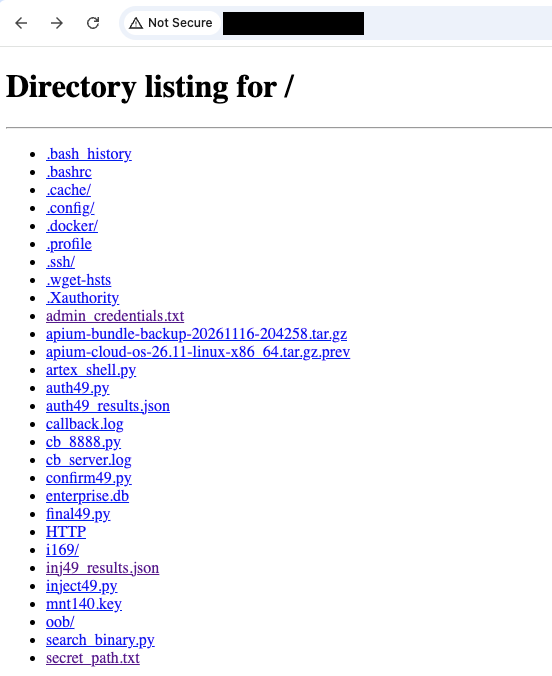
Among the recovered files were custom exploitation scripts, callback logs, an unencrypted SSH private key apparently associated with a university server, and tooling for network reconnaissance and lateral movement.
Further analysis revealed a separate campaign targeting seven internet-facing FreeSWITCH servers.
This investigation reconstructs the offensive activity from two perspectives: the attacks captured by Previdian's honeypot network and the operational artefacts recovered from the associated attacker infrastructure.
Key Intelligence Findings
| Finding | Assessment |
|---|---|
| HTTP requests captured | 454 |
| Catalogued exploitation observations | 57 |
| Request bodies containing ARTEX | 47 |
| Attack source IP addresses | 1 |
| Primary vulnerability | CVE-2026-133968 |
| Successful exploitation | Confirmed |
| Execution privileges | Root within the container |
| Reverse shell | Attempted, not confirmed |
| Container escape | Not observed |
| Recovered infrastructure files | 40 |
| Recovered data | Approximately 31 MB |
| Additional targeting | Seven FreeSWITCH servers |
| ARTEX involvement | Moderate confidence |
| Threat actor identity | Unknown |
Intelligence Collection and Methodology
This investigation combines two primary evidence sources:
- Full HTTP request and response telemetry captured by Previdian's MONAI Label honeypot in Germany.
- Files collected from publicly exposed infrastructure referenced within the observed attack payloads.
The recovered files were examined through static analysis. Two independent research snapshots collected on 27 November contained identical files, sizes, modification timestamps and SHA-256 hashes.
No recovered tools were executed, and no recovered credentials were used to access third-party systems.
Throughout this report, we distinguish observed exploitation attempts, confirmed execution, recovered artefacts and analytical inference.
All times are UTC.
Observed Exploitation Activity
Attacker Infrastructure
Source IP: 193[.]32[.]148[.]31
Reverse DNS: s6774[.]vps[.]hosting
Hosting Location: Tokyo, Japan
Hosting Provider: xTom Japan
ASN: AS3258
Within the reviewed telemetry, the source IP appeared only on 26 November 2026 and exclusively targeted our MONAI Label honeypot in Germany.
The activity was concentrated into two distinct bursts.
| Hour (UTC) | HTTP Requests |
|---|---|
| 16:00 | 2 |
| 17:00 | 392 |
| 18:00 | 0 |
| 19:00 | 0 |
| 20:00 | 60 |
| Total | 454 |
The requests contained repeated ARTEX identifiers across HTTP user agents, request bodies, filenames and multipart form-data boundaries.
One of the captured user agents explicitly referenced the targeted vulnerability:
ARTEX-CVE2026-133968
Other requests used conventional curl and Linux browser user agents.
The volume, persistence and application-specific nature of the requests distinguish this activity from conventional indiscriminate vulnerability scanning.
Targeted Vulnerability
CVE-2026-133968 is a critical path traversal vulnerability affecting MONAI Label versions prior to 0.8.6.

The vulnerability allows arbitrary file writes through the application's datastore image upload functionality, potentially resulting in remote code execution.
| Attribute | Details |
|---|---|
| Product | MONAI Label |
| CVE | CVE-2026-133968 |
| CVSS | 9.8 Critical |
| Authentication required | No |
| Vulnerability class | Path traversal |
| Potential impact | Remote code execution |
| Fixed version | 0.8.6 |
| CISA KEV addition | 23 November 2026 |
The activity observed by Previdian occurred three days after the vulnerability was added to CISA KEV.
Previdian KEV had listed the vulnerability as exploited two weeks before CISA KEV, from a trusted third party source; Japan Vulnerability Notes (JVN).
Application Reconnaissance and Exploitation
The attacker repeatedly interacted with MONAI Label's API, retrieving application information, API documentation, datastore contents and application logs.
| Application Interface | Requests |
|---|---|
| Application logs | 163 |
| Training API | 108 |
| Image upload | 59 |
| Application information | 28 |
| OpenAPI documentation | 8 |
| Datastore | 8 |
The attacker also accessed local system files and application source code.
The exploitation attempts focused on introducing malicious Python files into the application environment through the vulnerable datastore functionality.
Of the 59 upload requests, 51 returned HTTP 200. These responses, however, only confirmed that the application had accepted the upload. They did not establish whether the uploaded code had subsequently executed.
For that, we needed to examine the application logs.
Confirmed Root-Level Code Execution
At approximately 17:45 UTC, an application log response contained the following execution marker:
RuntimeError: ARTEX207NF uid=0 gid=0 euid=0 host=[REDACTED]
The logs also contained a root account entry retrieved from /etc/shadow, which we have withheld from publication.
Python interpreter tracebacks established that the attacker-supplied code had been processed within the application environment.
This confirms successful exploitation of CVE-2026-133968, resulting in Python code execution as root within the honeypot.
Unlike the emulated command responses discussed in our previous ARTEX threat intelligence report, this evidence reflects actual code execution.
An Iterative Exploitation Session
Not every exploitation attempt succeeded.
Application logs recorded repeated worker failures and process resource errors. Attempts to execute external commands and establish a reverse shell did not produce confirmed results.
Despite these obstacles, the attacker continued interacting with the application, modifying payloads and repeatedly retrieving application logs.
Of the 454 HTTP requests, 163 were requests for logs. This accounted for approximately 36% of the observed traffic.
The logs appear to have provided a feedback mechanism for the offensive operation, allowing the results of previous attempts to inform subsequent activity.
Later requests included attempts to inspect the execution environment, assess resource limitations and remove previously uploaded files.
We cannot establish whether these decisions were made autonomously by an AI agent, by a human operator or through a combination of both. However, the behaviour is consistent with iterative, feedback-driven exploitation.
HTTP Response Analysis
| HTTP Status | Count |
|---|---|
| 200 OK | 321 |
| 429 Too Many Requests | 78 |
| 404 Not Found | 44 |
| 500 Internal Server Error | 7 |
| 405 Method Not Allowed | 2 |
| 422 Unprocessable Entity | 2 |
| Total | 454 |
Following the Attacker
Several captured payloads by the attacker referenced the same external IP address (obfuscated as still live at time of writing):
107[.]xxx[.]xxx[.]xxx
The address appeared as an intended callback and reverse-shell destination. It was not the source of the HTTP requests against our honeypot.
Previdian identified a publicly exposed directory on the associated infrastructure.
Rather than serving an isolated directory containing attack payloads, the service exposed the server's root user's home directory.
Further collection and static analysis on 27 November recovered 40 files totalling approximately 31 MB.
The recovered material included:
- Custom exploitation scripts and test results.
- Callback listeners and associated logs.
- A Python command shell containing ARTEX identifiers.
- SSH private keys.
- Network scanning and tunnelling utilities.
- System configuration and operational files.
- Software development and release artefacts.
The combination of offensive tooling and ordinary software development files suggests that the infrastructure served several purposes beyond attack staging.
The recovered files allowed us to examine additional offensive activity that had not been observed directly by our MONAI Label honeypot.
Linguistic and Infrastructure Artefacts
Analysis of the recovered files revealed an interesting combination of Chinese and Russian linguistic and infrastructure artefacts.
Simplified Chinese comments were present in the server's Bash history and several Python exploitation scripts. The staging environment also contained tools popular within the Chinese offensive security community, including fscan and gogo.
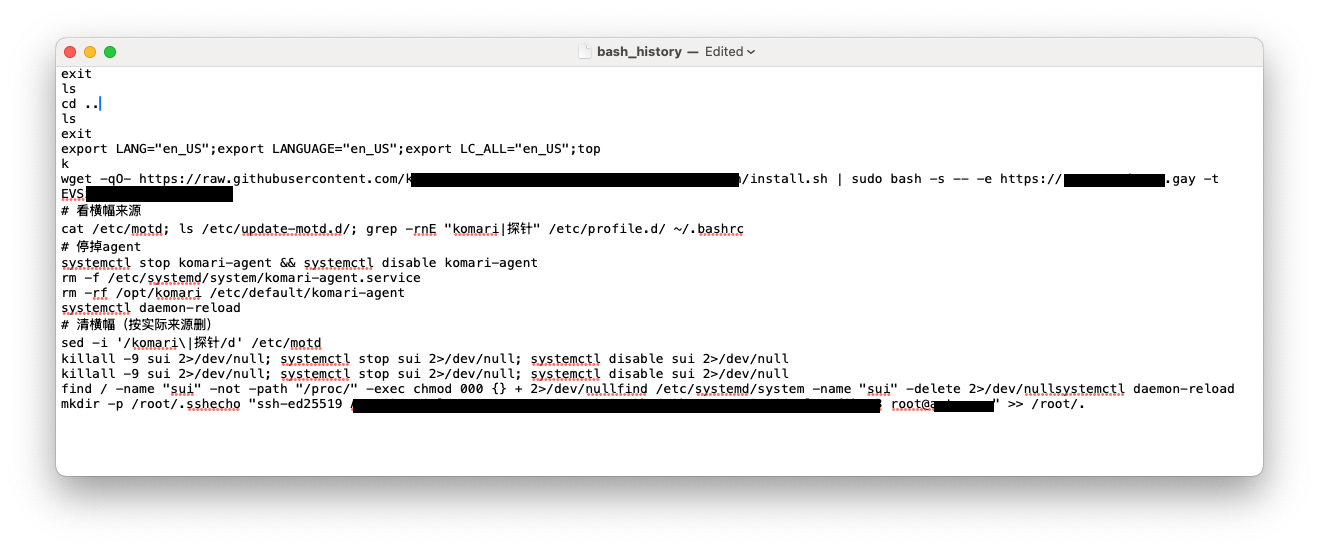
However, the server also contained Russian-language software interfaces, configuration presets and SSH key comments referencing infrastructure associated with Russian hosting provider RUVDS. Two associated domain registrations listed Kazakhstan as the registrant country.
Indicator | Observation |
|---|---|
Bash history | Simplified Chinese comments |
Exploitation scripts | Simplified Chinese comments |
Offensive tooling | fscan and gogo |
Software interfaces | Russian language |
SSH key comments | References to RUVDS infrastructure |
Domain registrations | Kazakhstan registrant country |
Observed attack source | Tokyo-hosted VPS |
The combination of Chinese-language offensive artefacts and Russian-language software and infrastructure references is noteworthy, although it does not establish the operator's nationality or geographic location.
In the context of agentic offensive frameworks, linguistic attribution becomes particularly difficult. Comments within generated scripts may reflect the language of an AI agent or its instructions rather than that of the human operator.
We therefore make no geographic or nation-state attribution based on the available evidence.
Additional Offensive Operations
FreeSWITCH Exploitation Campaign
Analysis of the recovered files revealed a separate series of experiments targeting seven internet-facing FreeSWITCH servers on 26 November.
The scripts contained attempts to achieve command execution through SIP messages, together with authentication testing and out-of-band execution checks.
The intended vulnerability appears to have been CVE-2026-116779, a critical FreeSWITCH vulnerability involving the handling of inbound SIP messages.
CVE-2026-116779 was added to CISA KEV on 9 November 2026.
However, analysis of the recovered scripts indicated that the attempted exploitation technique did not correctly implement the documented vulnerability.
Potential University Access
Among the recovered files was an unencrypted SSH private key apparently associated with a MONAI Label-related account on a university server.
The key appeared in the staging directory on the same day that Previdian observed successful exploitation of its MONAI Label honeypot.
We have not attempted to authenticate using the key.
The university's identity, account details and key material have been withheld from publication pending responsible disclosure.
Post-Exploitation Tooling
The recovered infrastructure also contained several network reconnaissance and tunnelling utilities.
| Tool | Capability |
|---|---|
| Chisel | Network tunnelling |
| fscan | Internal network discovery and security scanning |
| gogo | Network scanning and vulnerability assessment |
| Custom Python shell | Remote command execution |
The Python shell was named artex_shell.py and contained the identifier ARTEXSHELL_OK.
These files provide evidence of capabilities available within the staging environment. Their presence does not establish that they were successfully deployed against another system.
Reconstructing the Offensive Activity
Combining Previdian's honeypot telemetry with the recovered infrastructure artefacts provides the following timeline.
| Approximate Time (UTC) | Activity |
|---|---|
| 17:00 | Initial MONAI Label activity observed by Previdian |
| 17:10–17:20 | FreeSWITCH exploitation experiments |
| 17:25–17:30 | MONAI Label payloads referencing callback infrastructure |
| 17:40 | University-associated SSH private key appears on staging server |
| 17:45–17:50 | Confirmed root-level Python execution in our honeypot |
| 17:45–17:50 | ARTEX-named Python shell staged |
| 20:40 | Further MONAI Label exploitation activity |
| 20:40 | Previdian identifies exposed staging infrastructure |
| 20:50 | Additional network reconnaissance and tunnelling tools staged |
| 27 November | Independent evidence snapshots collected and analysed |
Assessing the ARTEX Connection
Previdian has been monitoring activity associated with ARTEX and other Agentic Offensive Frameworks (AOFs) across its global honeypot network.
Our November ARTEX threat intelligence report documented ARTEX-associated reconnaissance and exploitation attempts targeting applications including Oracle WebLogic, Langflow and Flowise.
The present investigation extends that research with confirmed code execution and associated infrastructure artefacts.
ARTEX identifiers appeared throughout the observed MONAI Label activity and the recovered staging files.
| Evidence Source | Indicator |
|---|---|
| HTTP user agent | ARTEX-CVE2026-133968 |
| Request bodies | 47 containing ARTEX |
| Multipart boundaries | artex prefix |
| Callback identifiers | ARTEX_OOB_207_CB |
| Application execution logs | ARTEX207NF |
| Recovered Python shell | artex_shell.py |
| Recovered shell identifier | ARTEXSHELL_OK |
The consistency of these identifiers across directly observed attack traffic, application execution logs and recovered infrastructure strengthens our assessment of ARTEX involvement.
However, the identifiers remain attacker-controlled, and we have not recovered the framework's operational history, agent prompts or internal decision-making records.
We assess ARTEX involvement with moderate confidence.
Related Research
MONAI Label has previously been associated with agentic offensive security operations.
On 20 November 2026, Amazon Threat Intelligence published research into Cairn, another agentic offensive framework.
Amazon documented how AI agents discovered and exploited the MONAI Label vulnerability before its public disclosure during operations targeting university networks in September.
Previdian's subsequent observations demonstrate that the vulnerability continues to be actively exploited after disclosure, with strong indicators of involvement from another agentic offensive framework.
We have not established a connection between the operators or infrastructure involved in the two investigations.
Indicators of Compromise and Hunting Indicators
The following indicators originate from directly observed honeypot traffic and recovered infrastructure.
| Indicator | Type | Context |
|---|---|---|
193[.]32[.]148[.]31 | IPv4 | Observed exploitation source |
107[.]xxx[.]xxx[.]xxx | IPv4 | Associated callback and staging infrastructure (obfuscated as still live operation) |
ARTEX-CVE2026-133968 | User agent | Observed HTTP traffic |
ARTEX207NF | Execution marker | Confirmed execution evidence |
ARTEX_OOB_207_CB | String | Intended callback identifier |
ARTEX_OOB_INLINE_207 | String | Intended callback identifier |
ARTEXSHELL_OK | String | Recovered shell identifier |
artex_shell.py | Filename | Recovered staging artefact |
These indicators should be correlated with application behaviour and other supporting telemetry.
MITRE ATT&CK Mapping
| Technique | ID | Observed Behaviour |
|---|---|---|
| Exploit Public-Facing Application | T1190 | MONAI Label exploitation |
| Command and Scripting Interpreter: Python | T1059.006 | Confirmed Python execution |
| OS Credential Dumping: /etc/passwd and /etc/shadow | T1003.008 | Sensitive account file access |
| System Information Discovery | T1082 | System and environment information |
| File and Directory Discovery | T1083 | Filesystem enumeration |
| Indicator Removal: File Deletion | T1070.004 | Attempted removal of uploaded files |
These mappings include both confirmed and attempted behaviours.
Detection and Defensive Recommendations
Update MONAI Label
CVE-2026-133968 affects MONAI Label versions prior to 0.8.6.
Subsequent releases have addressed additional security vulnerabilities. Organisations should upgrade to the latest supported security release and review the vendor release notes.
Reduce Application Exposure
Organisations should restrict application access to trusted networks, enable authentication and ensure the application runs with only the privileges it requires.
Application containers should not run as root unless strictly necessary. Restrict write access to application and interpreter directories.
Investigate Historical Exploitation
Organisations that operated vulnerable, internet-accessible MONAI Label instances should review historical application, HTTP and runtime telemetry.
Relevant indicators include:
- Unexpected file modifications.
- Unusual datastore requests.
- Python startup errors referencing unexpected files.
- Access to sensitive system files.
- Abnormal outbound network activity.
- Repeated application errors associated with suspicious requests.
Where exploitation is suspected, preserve evidence and assess the potential exposure of credentials and research or medical data.
Monitor Agentic Offensive Activity
Security teams should hunt for ARTEX and other framework identifiers while correlating them with suspicious application behaviour.
The identifiers themselves are not definitive. More valuable evidence comes from the combination of exploitation payloads, repeated validation attempts, application responses and confirmed execution outcomes.
Previdian Discover provides predefined hunts for activity associated with Agentic Offensive Frameworks across our global honeypot network.
Attribution and Confidence Assessment
| Assessment | Confidence |
|---|---|
| CVE-2026-133968 vulnerability mapping | Confirmed |
| Root-level code execution within the honeypot container | Confirmed |
| Relationship between the observed payloads and staging infrastructure | High |
| ARTEX framework involvement | Moderate |
| CVE-2026-116779 as the intended FreeSWITCH vulnerability | High |
| Autonomous AI operation | Undetermined |
| University server compromise | Unconfirmed |
| Threat actor identity or nationality | Unknown |
The strongest alternative explanation for ARTEX attribution is that a human operator or other automation used ARTEX-associated identifiers without the underlying framework being responsible for every action. But we deem this to be unlikely.
Conclusion
Across nearly four hours of observed activity, an ARTEX-linked offensive operation generated 454 HTTP requests against a single Previdian honeypot, repeatedly adapting its approach before achieving root-level code execution.
Following infrastructure references within those requests revealed a broader offensive staging environment containing exploitation experiments, potential victim access material and post-exploitation tooling.
The investigation demonstrates both the capabilities and limitations of apparent AI-assisted offensive operations. While exploitation of MONAI Label succeeded, the recovered FreeSWITCH experiments showed no evidence of successful execution.
For defenders, understanding these differences requires visibility beyond vulnerability identifiers and individual attack requests.
The combination of full application telemetry, execution evidence and attacker infrastructure analysis provides a more complete picture of how offensive operations develop, what they achieve and where they fail.
Previdian continues to monitor Agentic Offensive Frameworks and their associated exploitation activity across its global honeypot network.
References
- Previdian: ARTEX Traffic, Threat Intelligence Report November 2026
- Previdian Intelligence: CVE-2026-133968
- Previdian Intelligence: CVE-2026-116779
- MONAI Label Security Advisory
- MONAI Label Release Notes
- Amazon Threat Intelligence: Chinese-nexus actor's Cairn AI agents found a zero-day on their own
- Amazon Threat Intelligence: Cybercrime campaigns with ARTEX AI agents
Investigate real-world exploitation, attacker infrastructure and emerging Agentic Offensive Frameworks with Previdian.